Skip to content
NOOSPHEREDownload
← All labs
Histonaut Live

Bio lab

Nanorobots in living tissue, whole-brain connectomes, electrodes and silent speech, drug interactions and the data that grounds them.

Engine: Histonaut (ships with the app). PyTorch simulation engine of the Bio lab (CUDA when available).

scenarios

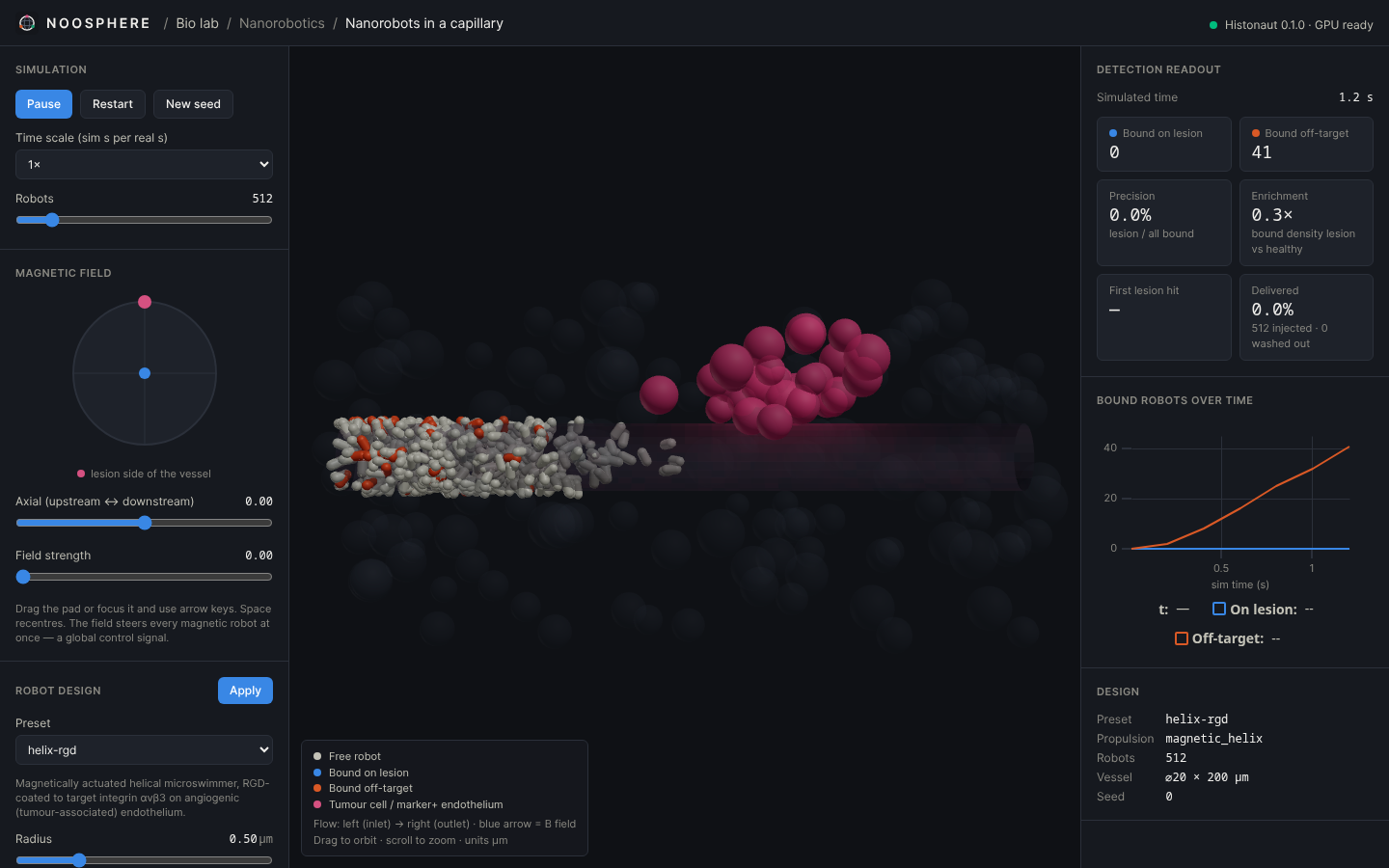
Nanorobots in a capillary running in NOOSPHERE
Nanorobotics Live

Nanorobots in a capillary

Steer targeted nanorobots through a micro-vessel past an early tumour lesion and measure how well they find it.

Goal: Find an early lesion from inside the bloodstream: robots should bind where the endothelium is marker-positive and nowhere else.

How it is measured

  • Robots bound on lesion vs off-target
  • Precision and enrichment
  • Time to first lesion hit
  • Delivered fraction of dose
low-Re physicsmagnetic controldetection metrics
Nanorobotics Planned

Nanorobot design optimiser

Search robot size, propulsion and surface chemistry for the best detection at a fixed dose — the Pareto front of sensitivity vs off-target binding.

Goal: Turn the robot design into a parameter vector and optimise it against a detection objective, across many randomised tissues.

How it is measured

  • Lesion binding at fixed dose
  • Off-target binding
  • Robustness across tissue seeds
Optuna / CMA-ESdifferentiable simPareto front
Nanorobotics Planned

Cell-defence swarm

Train nanorobot swarms with reinforcement learning to clear pathogens in tissue while sparing healthy host cells.

Goal: Learn control policies — a global field controller or per-robot policies — that defend tissue better than hand-written strategies.

How it is measured

  • Pathogen clearance over time (AUC)
  • Collateral host-cell damage
  • Robots lost or cleared
multi-agent RLPPO / MAPPOGPU
Neuroscience Planned

Fruit-fly connectome

Explore and simulate the whole adult Drosophila brain wiring diagram (~140k neurons, ~50M synapses) and probe circuits by activating neurons.

Goal: Load a complete fly connectome, browse neurons and pathways, and run whole-brain spiking simulations to predict which neurons respond to a stimulus.

How it is measured

  • Agreement with published activation experiments
  • Pathway length and convergence
  • Simulation speed (neurons × seconds / s)
FlyWiregraph analysisspiking simulation
Pharmacology Planned

Drug–drug interactions

Predict and explain which drug combinations interact — pharmacokinetic (e.g. CYP450) and pharmacodynamic — and how confident we can be.

Goal: Score drug pairs for interaction risk and side effects, with an explanation (shared enzyme, transporter or target) for every prediction.

How it is measured

  • AUROC and AUPRC
  • Drug-level (cold-start) splits to avoid leakage
  • Calibration of risk scores
knowledge graphGNNpolypharmacy
Data Planned

Tissue atlas

Load spatial transcriptomics and protein maps of a human tissue region and turn them into simulation-ready tissues.

Goal: Go from a real tissue dataset to a scenario: cell types, marker expression (e.g. EPCAM, ERBB2, ITGAV/ITGB3) and vessel geometry in place.

How it is measured

  • Coverage of cell types
  • Marker contrast lesion vs healthy
AnnData .h5adOME-TIFFspatial omics
Neuroscience Planned

Electrode and EEG simulator

Place scalp, cortical or depth electrodes on a head model and see what each one records from simulated brain activity.

Goal: Go from sources in the brain to signals at electrodes, so electrode layouts and decoders can be tested before anyone wears a cap.

How it is measured

  • Agreement with a reference forward solver (MNE-Python)
  • Decoder accuracy on real data after simulated pre-training
BCIforward modelsynthetic recordings
Neuroscience Planned

Silent speech interface

Simulate the path from facial muscle activity to text: electrodes, amplifier and converter, then a recogniser for silently mouthed commands.

Goal: Find the cheapest measurement chain that still recognises a small silent command vocabulary, before any hardware is bought.

How it is measured

  • Command error rate per chain
  • Cheapest chain under a target error
sEMGmeasurement chaincommand recognition

Other labs